
Fiber Optic Cabling in Sacramento CA – Single-Mode, Multimode & Fusion Splicing
Telecommunications Contractor in Sacramento CA installing indoor, outdoor and riser-rated fiber, fusion-spliced, terminated and certified for backbone, campus and building-to-building links.
Fiber carries your network between telecom rooms, floors and buildings at speeds and distances copper cannot reach. Our licensed C-7 crews (CSLB #[NUMBER]) pull, splice and terminate single-mode and multimode fiber, then prove every strand with Tier 1 loss testing and Tier 2 OTDR traces before we hand it over.
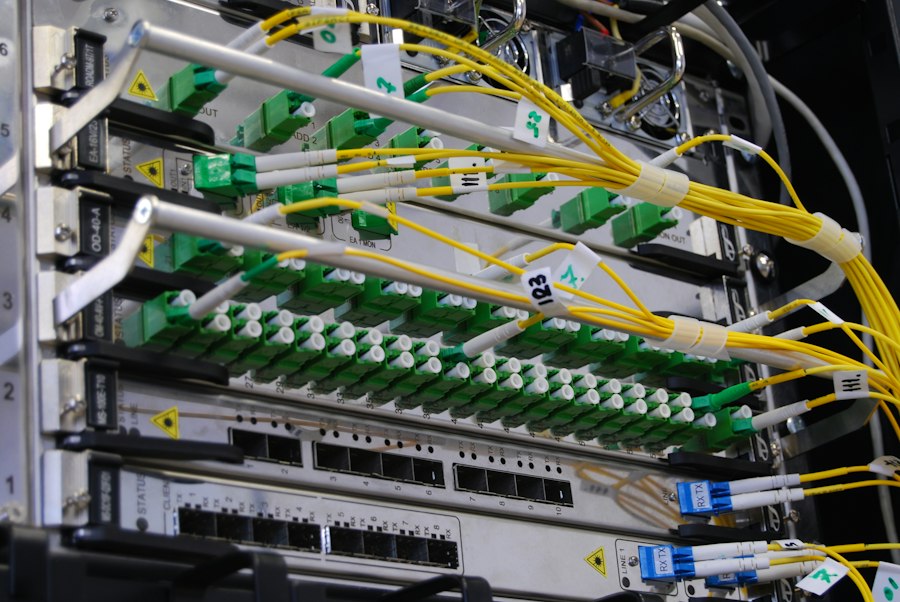
Commercial Cabling and Fiber Backbone in Sacramento CA
Fiber optic cable sends data as pulses of light through strands of glass, which lets it carry far more bandwidth over far longer distances than copper. It is also immune to electrical interference, which makes it the right choice for backbone links, long warehouse runs, industrial areas and connections between buildings.
We install the full range of commercial fiber: multimode for in-building backbone between your MDF and IDFs, single-mode for long runs and campus links, and indoor/outdoor or outside-plant cable for underground conduit between buildings. Every cable is rated for the space it passes through, protected in innerduct where needed and installed within its bend-radius and pulling-tension limits.
On every project, fiber is planned together with the rest of your cabling system. Backbone strand counts, patch panel and enclosure space, and connector types are matched to your switches and your plans for growth, so the fiber you install today keeps working through several generations of network equipment.
Fiber Optic Cabling Services We Provide in Sacramento CA
Our technicians install, label and test every cable themselves, following the ANSI/TIA standards used by cable contractors across the United States. Most jobs combine two or three of these services in a single mobilization.
Fiber Optic Installation
Single-mode and multimode fiber pulled through innerduct, conduit and tray for in-building backbone, long warehouse runs and building-to-building links.
Learn more about fiber optic installation →Fiber Optic Splicing
Low-loss fusion splicing with core-alignment splicers for pigtails, cable extensions and repairs, housed in labeled splice trays and closures.
Learn more about fiber optic splicing →Fiber Termination
LC, SC and MPO/MTP connectivity terminated into rack-mount enclosures, adapter panels and wall-mount boxes, labeled strand by strand.
Learn more about fiber termination →OTDR Testing & Certification
Tier 1 loss testing and Tier 2 OTDR traces on every strand, with end-face inspection, polarity checks and full test reports at handoff.
Learn more about OTDR testing & certification →Single-Mode vs Multimode Cable Types in Sacramento CA
The right fiber depends on distance, speed and where the cable runs. Here is how the common types compare.
| Fiber type | Wavelength | Typical reach at 10 Gbps | Best for |
|---|---|---|---|
| OM3 multimode | 850 nm | Up to 300 m | Shorter in-building backbone and data rooms |
| OM4 multimode | 850 nm | Up to 400 m | MDF-to-IDF riser backbone in most commercial buildings |
| OS2 single-mode | 1310 / 1550 nm | 10 km and beyond | Campus, building-to-building and long warehouse runs |
Our usual recommendation: OM4 multimode for short backbone inside a single building, and OS2 single-mode for anything longer or between buildings. When a building is likely to need higher speeds later, single-mode gives you the most room to grow, and we will price both options on your quote.
Fiber Splicing & Termination in Sacramento CA
A fiber link is only as good as its joints. We fusion-splice factory-polished pigtails onto incoming fiber for the lowest possible loss, and house every splice and connector in protected enclosures that are labeled and easy to service.
- Fusion splicing with core-alignment splicers
- Pigtail splicing to LC and SC connectors
- Rack-mount fiber enclosures and adapter panels
- Wall-mount fiber boxes for small IDFs
- Splice trays and outdoor splice closures
- Pre-terminated MPO/MTP trunk installation
- Fiber patch cord installation and management
- Damaged fiber repair and re-splicing
- Strand-by-strand labeling and documentation
Our Fiber Installation Process in Sacramento CA
Route survey and design
We walk the route between rooms or buildings, confirm pathways and conduit, and size strand counts for today and the future.
Itemized quote
You receive a line-item price for cable, enclosures, connectors, splicing, labor and testing, with fiber type options where it makes sense.
Pathway and cable pull
Fiber is pulled in innerduct, conduit or tray within its tension and bend-radius limits, with slack loops left for future service.
Splicing and termination
Strands are fusion-spliced to pigtails or terminated and mounted in labeled enclosures at each end.
Tier 1 and Tier 2 testing
Each strand is loss-tested against its budget and traced with an OTDR, and any problem is fixed and re-tested on site.
Handoff and documentation
You receive test reports, OTDR traces, strand maps and labeled drawings, with a walk-through for your IT team.
Fiber Optics Testing & Certification in Sacramento CA
Fiber that lights up is not the same as fiber that passes certification. We test every strand two ways, so you know both how much light reaches the far end and exactly where any loss along the cable comes from.
- Tier 1 insertion loss with light source and power meter
- Loss compared against a calculated link budget
- Testing at both wavelengths for the fiber type
- Polarity verification
- Tier 2 OTDR traces for every strand
- Splice and connector loss from the OTDR event table
- Connector end-face inspection
- Report IDs that match strand labels
Fiber Optic Problems We Solve in Sacramento CA
Slow links between floors
Old copper risers limit uplink speed. We replace them with fiber that supports 10 Gbps and beyond between your MDF and IDFs.
IDF too far from the MDF
Copper stops at 100 meters. Fiber reaches remote IDFs in large warehouses and campuses without extra equipment in between.
Connecting a second building
We install outdoor-rated fiber through underground conduit to link offices, shops and portables onto one network.
Damaged or cut fiber
We find the break with an OTDR, splice in a repair and re-certify the link, often the same day.
High loss or failed tests
Dirty connectors and poor splices cause intermittent errors. We clean, inspect and re-splice until every strand passes.
Electrical interference
Near motors, welders and heavy power, copper picks up noise. Fiber carries data cleanly through industrial environments.
Fiber Optic Cabling for Sacramento CA Businesses
Offices
Riser fiber between floors and fiber to server rooms in multi-story office buildings.
Warehouses
Long single-mode runs to remote IDFs, dock offices and mezzanines.
Schools
Campus backbone linking classroom buildings, gyms, offices and portables.
Medical Facilities
High-capacity backbone for imaging, records and clinical systems.
Retail
Fiber links to back offices, stockrooms and multi-tenant shopping centers.
Industrial Facilities
Armored and outdoor-rated fiber that resists interference on plant floors.
Fiber Optic Cabling Questions from Sacramento CA Customers
Should I use single-mode or multimode fiber?
Multimode (OM3 or OM4) is cost-effective for shorter runs inside a building, such as MDF-to-IDF backbone up to a few hundred meters. Single-mode (OS2) is the right choice for long runs, building-to-building links and anything you want to support much higher speeds in the future. Many buildings get both.
What is fusion splicing?
Fusion splicing joins two fibers by melting them together with a precisely aligned electric arc. It creates a permanent, very low-loss joint and is how we attach factory-polished pigtails to incoming fiber and repair or extend existing cables.
How is fiber tested?
Every fiber gets Tier 1 testing with a light source and power meter to measure total loss against the link budget. We also run Tier 2 OTDR traces, which show the loss of each splice and connector along the cable and the location of any fault.
Can you repair a damaged fiber cable?
Yes. We locate the break with an OTDR, then fusion-splice in a repair section or replace the damaged length, and re-test the link to confirm it is back within budget.
Can you run fiber between buildings?
Yes. We install outdoor-rated and indoor/outdoor fiber in underground conduit and innerduct between buildings on a campus, with proper transitions, bonding and splice enclosures at each end.
Request a Fiber Optic Cabling Quote in Sacramento CA
Tell us where the fiber needs to go and how many strands you need. We will survey the route and send an itemized quote.
Need new fiber, a splice or a repair?
Send us your building layout, the rooms or buildings to connect and your timeline, and we will plan the fiber route around your schedule.
(279) 206-4379 Request a Quote